The painting Dreaming Respite in the Wutong’s Shade《桐阴清梦图》is a figure-painting by the renowned Ming dynasty master Tang Yin (唐寅, 1470-1523). As part of the notable collection of The Palace Museum, Beijing, this work holds a certain prized value as it is handed down from a prominent painter of the Ming dynasty.
Although the painting is undated, the poem inscribed by the artist suggests that Tang Yin had stopped pursuing his scholar-official career at this time and settled down to lead a quiet rustic life. Utilizing a combination of Chinese ink wash and baimiao (line drawing with brush) technique, the painting depicts a scholar reclining on a folding chair under an imposing wutong tree with his eyes closed, conveying a sense of serenity and introspection. The wú tóng tree or the Chinese parasol tree (Firmiana simplex) is native to China and some parts of East Asia. Traditionally considered as the tree par excellence and symbolically associated with the phoenix, it was commonly planted in the courtyards of Chinese homes in the past in the hope that the auspicious phoenix would descend and bless the household.
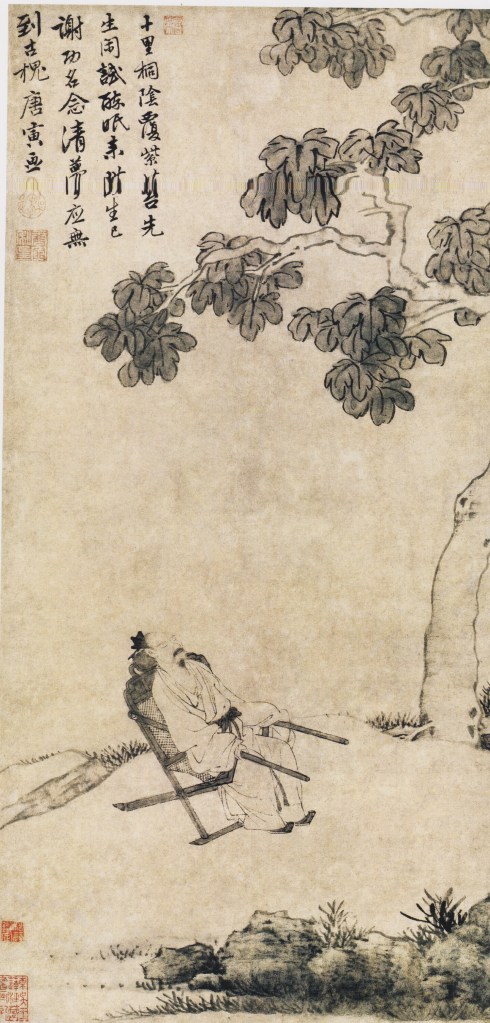
Tang Yin (唐寅). Dreaming Respite in the Wutong’s Shade.《桐阴清梦图》Hanging Scroll. Chinese Ink and Colour on paper. 62 x 30.8 cm. Ming Dynasty. Collection of The Palace Museum, Beijing.
With its simple composition, refined brushwork and elegant style, the painting stands as a quintessential exemplar of Tang Yin’s figure painting. The fine integration of his poem, calligraphy and painting demonstrates a harmonious relationship between the three important arts in Chinese culture. The painting bears an inscription of a quatrain by the artist and is impressed with three of his seals. (relief: Wuqu and Tang Ada; intaglio: Tang Yin siyin). The two collector seals are traceable to Wang Wenyuan (Songlian jianding and dongwu Wang Lianjing cang shu hua ji) of the Qing Dynasty. Tang Yin was a leading figure in the Ming literati painting alongside Shen Zhou, Wen Zhengming and Qiu Ying. They were celebrated as the “Four Masters of Wumen school.” This painting belongs to the precious collection of The Palace Museum in Beijing. The Palace Museum was established in 1925 and housed within the historic Forbidden City. The museum holds an encompassing collection of cultural artefacts and artworks from the Ming and Qing dynasties. The Forbidden City was where 24 emperors of Ming and Qing dynasties managed administrative business and resided, and gradually building an extensive collection of artworks under the imperial court and patronage.

