
Below are sections of informative articles that will contribute to the understanding and appreciation of fine art as an engaging discourse, collectible or investment.
—————————————————————————————–
What You Need to Know from the Art Market 2020 Report
ARTSY EDITORIAL BY BENJAMIN SUTTON, 5 March 2020
The global art market shrunk by 5% in 2019 with a total of $64.1 billion in sales, according to economist Clare McAndrew’s report “The Art Market 2020,” released by Art Basel and UBS on Thursday. That represented a drop of $3.3 billion in sales from 2018, which was the art market’s biggest year in half a decade, with total sales of $67.4 billion.
The report seems to confirm what many observers had speculated: that a string of geopolitical conflicts, trade disputes, and political upheavals created a more cautious market generally, and that a dearth of masterpieces coming to auction—especially in the second half of the year—had made for a sluggish year.
The world’s three biggest art markets—the United States, China, and the United Kingdom—all saw declines in 2019, in no small part due to macroeconomic and political factors such as the U.S.–China trade war and the protracted Brexit negotiations. Geopolitical factors may have also held up the supply of major works coming to auction, leading to a 17% drop in auction sales from 2018 to 2019. Last year saw a total of $24.2 billion in sales of fine art, antiques, and decorative art at public auctions.
Auction sales take a hit
The drop was especially acute at the top level of the auction market, with lots that sold for more than $10 million accounting for 20% of all auction sales by value in 2019, down from 28% of all auction sales in 2018. That year-on-year decline bolsters recent market analysis that identified a drop in major lots coming to auction in the latter half of 2019.
“This year it was the high end that had the worst fall in terms of year-on-year value,” McAndrew said. “With so much going on and so many things happening where you think people’s minds couldn’t be on fine art and antiques, the market probably did quite well considering, even though it declined.”
While the climate of global tension that defined 2019 may have led some would-be buyers and sellers to hold back on executing major transactions at auction, others opted to do their business privately. Private sales at Christie’s and Phillips increased dramatically in 2019—by 24% to $811 million and by 34% to $172 million, respectively. At Sotheby’s, private sales held stable at about $1 billion.
“What we saw in previous years, like 2016, is that when the general context is kind of uncertain and there’s a lot of anxiety, people tend to either hold back completely, especially at the high end, or they do things that are perceived to be slightly safer, like selling things privately,” McAndrew said.
Uneven gallery growth
Collectors pursuing potentially safer means of selling art meant not only growth for auction houses’ private sales businesses, but also that gallery sales held steady, ticking up 2% year-on-year, for a total of $36.8 billion. That figure represented 58% of the overall market by value in 2019. That growth was erratically distributed among galleries of varying sizes: Galleries with annual turnovers between $250,000 and $500,000 and over $30 million saw their aggregate turnovers spike 17% and 16%, respectively; galleries with annual turnovers between $500,000 and $1 million, meanwhile, saw their aggregate turnovers drop 9% in 2019.
Big-ticket sales of works priced above $1 million drove the gallery market in 2019 even more so than in 2018. Sales of works for more than $1 million, while accounting for only 2% of all gallery sales by volume, accounted for a full 42% of all gallery sales by value. Meanwhile, the vast majority—84%—of sales by volume were works priced below $50,000, which accounted for only 27% of sales by value.
Some galleries fair better than others
The report’s art fair data underlined similar tensions between galleries with high annual turnovers and smaller outfits. Galleries with sales in excess of $10 million participated in twice as many fairs (eight) as the average for all galleries (four) in 2019. Sales at fairs also accounted for nearly half (47%) of all sales for galleries with an annual turnover of more than $10 million. However, for galleries with annual turnovers less than $500,000, fair sales accounted for just 30% of their business. For some smaller galleries, going to fairs to get 30% of their sales may not be enough to cover the enormous costs and logistical burdens of participation—dealers’ art fair costs for 2019 were estimated to total $4.6 billion.
“The costs tend to rise in tandem for everyone, but the sales very much skew toward the bigger galleries,” McAndrew said. “I’m not saying that some smaller galleries had very good things to say—that they do well at fairs, and they wouldn’t be able to get any kind of international foothold without them—but that is a big issue.”
One illuminating new metric in the report measures exactly what share of sales at fairs actually happen during fairs. This data is potentially useful in explaining how mega-galleries—many of which have staffers dedicated exclusively to collector relations and fair programming—are able to thrive in a fair setting. It has become accepted practice for galleries to circulate checklists of works by highly sought-after artists to top-tier collectors in the lead-up to a fair, so that many works may already be unavailable by the time the first VIPs step into the booth. Dealers reported making 15% of their fair sales (transactions that amounted to $2.5 billion) before fairs opened, and another 21% ($3.5 billion) after fairs had closed. Still, the majority of fair sales—64%, or $10.6 billion—actually happened during the fairs.
“A lot of the motivation for doing fairs is to generate that same kind of buzz you might get from it being a limited-time sale and a little competitive with other buyers,” McAndrew said. “It shows that there are so many layers of VIPs now—at the fair itself, but then there are all the ones that get access way before the fair.”
Connecting with New Collectors Online
And while fairs may still be a viable way for galleries to transact with collectors they already know—before, during, and after the fair—the report found that online sales are a potentially powerful mechanism for dealers to find new buyers. According to McAndrew’s analysis (which relied, in part, on data provided by Artsy), dealers made 37% of their sales to collectors who’d been working with the gallery for one to five years, with new buyers accounting for 34% of all sales. Meanwhile, dealers who sold works online in 2019 reported that 57% of those sales were to new buyers.
But even as online sales seemed to be bringing new collectors into the fold, their overall numbers declined slightly in 2019—down 2% to $5.9 billion, or 9% of the total art market—fairing only slightly better than the market’s overall dip. Those numbers lag behind the overall retail market, where 14% of sales took place online in 2019 (up from 12% in 2018). Online sales accounted for just 5% of dealers’ sales in 2019, with 3% happening on galleries’ own portals and websites, and the other 2% taking place on third-party platforms.
“There was a lot of headwind against the art market last year, whether it was tariffs, protectionist measures impacting how goods travel, sustainability issues, all these things,” McAndrew said. “And now with the coronavirus, it will be interesting to see—will it have a big effect on online sales or will the whole market get really subdued for a while?”
While online art sales did not see many big effects in 2019—despite galleries like Gagosian and David Zwirner doing serious business through their online viewing rooms – the report found that online sales had outsized significance for smaller galleries. Online sales accounted for 12% of all sales by value for galleries with turnover under $1 million, while they contributed only 1% of all sales by value for galleries with annual turnover of more than $10 million.
For complete article, please see https://www-artsy-net.cdn.ampproject.org/c/s/www.artsy.net/article/artsy-editorial-art-market-2020-report/amp

Computer Aided Colorimetric Analysis of Fine Art Paintings
by Jon Yngve Hardeberg and Jean-Pierre Crettez
Ecole Nationale Superieure des Tel ecommunications, Paris, France
(For complete article, please read http://www.ansatt.hig.no/jonh/archive/FineArt.pdf)
Introduction
In order to analyze paintings, specialists use many different techniques exploring different parts of the electromagnetic spectrum: near infra-red, ultra-violet, X-rays, etc. But surprisingly, the visual domain has rarely been analyzed, probably because color perception is a very complex domain, being rather difficult to analyze adequately by means of automatic techniques. Our visual sensations are the results of three different processes: physical, neuro-physical and psychophysical. Colorimetry is based on the evidence of trichromacy and the definition of a reference observer. It allows the measure of colors as luminous stimuli. For fine arts, it provides a way to quantify the paintings and their reproduction.
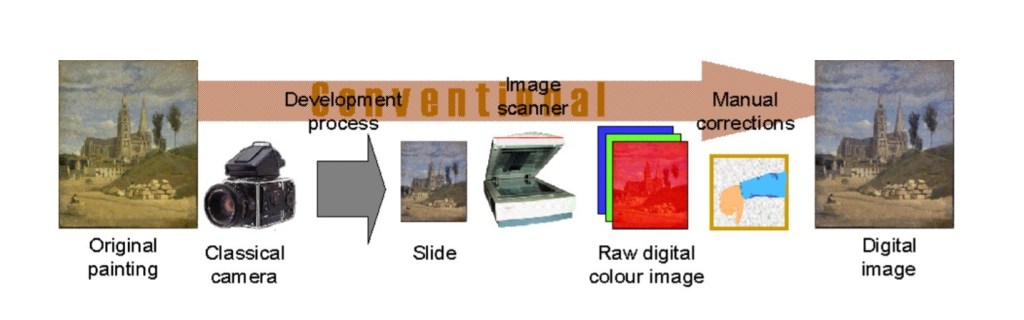
The colours of a fine art painting is indeed a very important property of the painting. Traditionally, the colours have mostly been evaluated qualitatively by observing the painting. Besides the obvious uncertainty stemming from the qualitative analysis, another important drawback with such methods is that it requires the curator or art historian to be located physically close to the painting. To perform a quantitative analysis of the colours of a painting, colour measuring devices such as colorimeters and spectrophotometers can be used. But, such equipment have a very poor spatial resolution, making it difficult to analyse the painting as a whole. We propose thus to apply digital image processing techniques to analyse the painting [1, 2, 3, 4]. However, to analyse and evaluate the colours in a painting it is important to be able to quantify them properly, in particular to make sure that the analysis is independent of the image acquisition device.
Image acquisition
Traditionally, the image acquisition process is quite complex and it is difficult to control how colour is being processed in the different steps, see Figure 1. The proposed digital image acquisition process is performed directly from the painting, without a photographic intermediary, using a high resolution CCD camera. The original methods which have been developed allows a perfect spatial resolution and an excellent colour fidelity. The acquisition is therefore independent of the light source and the acquisition equipment. The process of colorimetric characterisation of the camera providesthe transformation from the RGB values of the camera to the device-independent CIELAB colour space, using spectrally calibrated colour targets. These techniques have been applied to the acquisition of paintings shown during recent exhibitions in Paris, in particular for the making of a CD-ROM on Corot in collaboration with the French Museums Research Laboratory (LRMF).
Colorimetric analysis
Disposing of a colour-calibrated digital image representing the painting, we project every pixel of the image to its corresponding position in the 3-dimensional CIELAB space, thus obtaining a cloud of points representing all the colours used in the painting, the colour distribution. We perform a segmentation of the CIELAB space into different regions, such as light and dark colours, pastels and saturated colours etc. This segmentation in CIELAB space also provides a segmentation of the painting itself. We can then perform a colorimetric analysis of the resulting regions separately, and extract several properties, such as the precision of the nuances, colour harmonies, principal colours etc.
Creativity is the answer we’ve been looking for – now is the time to embrace and invest in it
By Marisa Henderson, Chief of the Creative Economy Programme, and Amy Shelver, Public Information Officer, UNCTAD
The 2021 UN Year of Creative Economy puts the ‘orange economy’ front and centre at a time when we need creative solutions for the world’s challenges. The final two months of 2019 marked a major milestone for the global creative community as the UN moved to ratify a resolution to make 2021 the International Year of Creative Economy for Sustainable Development.
This is a hard-won landmark for the creative industries. It recognizes and elevates the creative economy as an important tool for building a sustainable, inclusive, and equitable future. When the resolution was being negotiated and approved, no one could anticipate what the intervening year would hold: a status quo-shattering pandemic. But perhaps what has felt like the end of the world is the beginning of a new world.
What could be more fitting when entering a new era than a dedicated focus on creativity and the role it can play in helping us achieve the 2030 Agenda for Sustainable Development? More than ever, we need creative thinking, innovation and problem solving to imagine ourselves out of the furrow we’ve been in. The creative industries, the lifeblood of the creative economy, are well placed to help.
The creative economy, a long evolving concept, builds on the interplay between human creativity and ideas and intellectual property, knowledge and technology. Essentially, it is the knowledge-based economic activities on which the ‘creative industries’ are based. The creative industries, an important source of both commercial and cultural value, include advertising, architecture, arts and crafts, design, fashion, film, video, photography, music, performing arts, publishing, research & development, software, computer games, electronic publishing, and TV/radio.
A moment for momentum
With the formal announcement of the 2021 United Nations Year of Creative Economy for Sustainable Development, the creative economy was finally recognised as a powerful force for good, livelihoods, social cohesion and economic development through the trade in creative goods and services. The announcement also acknowledges the role of creative industries in supporting entrepreneurship, stimulating innovation and empowering people, including young people and women, while preserving and promoting cultural heritage and diversity.
The moment was a culmination of a decade of momentum behind the creative economy. Since 2008, multiple reports from United Nations agencies such as UNESCO, UNDP and UNCTAD have set the scene for an understanding of the creative economy and provided tools to help us ‘count’ culture and creativity.
The performance of the creative economy in the past two decades are indicative of both its impact and its potential. 2015 estimates by UNESCO and professional consulting firm EY put the contribution of the creative industries to global GDP at 3%. UNCTAD, which has been tracking the trade in creative goods and services for close to 20 years, found that creative economy export trade growth averaged 7% between 2002 and 2015, often outpacing the growth rate for other industries. In 2015, UNCTAD pegged the value of the global market for creative goods at a significant US$509 billion.
A chance to reimagine the creative economy
But the situation is not all roses and not everyone benefits from the creative economy equally. Developing countries face many challenges exporting their creative economy outputs, and we need to do more to protect intellectual property and improve data analysis for the industry. 2021 gives us the chance to spotlight both the creative economy’s value and its challenges.
Before COVID-19 hit, the global creative economy was growing fast in certain regions. This momentum should not be lost in the wake of the pandemic; rather, greater investment needs to flow to the creative industries that have the potential to make localised and high impact, and help us shift to more sustainable practice. With a decade to go to reach the SDGs, now is the moment to clearly map out and demonstrate how culture and creativity fit into the 2030 Agenda for Sustainable Development Agenda. We also need to come together to innovate on how to fund the creative and cultural targets within the SDGs.
Investment is the answer
Impact investing can and will play a critical role in this journey. Investment is the key to unlocking the true potential of the creative industries, and the returns from the creative economy are both promising and multi-dimensional – addressing social, cultural, innovation and economic needs. So, let us turn to creativity and draw on its full spectrum to shape the world while also harnessing its innovation potential and many positive returns..
This article was first published in a January 2021 report issued under the “Creativity, Culture, Capital” platform hosted by Fundación Compromiso and Upstart Co-Lab and Nesta’s Arts & Culture Finance. The platform was launched to showcase the potential of impact investment in the creative economy to drive social and environmental change.
中国艺术研究院成功举办“首届新质生产力与艺术高质量发展学术研讨会”
2024-02-04 来源:中国社会科学网
中国社会科学网讯 2月2日,“首届新质生产力与艺术高质量发展学术研讨会”在中国艺术研究院成功举办。此次研讨会由中国艺术研究院主办、中国艺术研究院摄影与数字艺术研究所承办,中国艺术研究院院长、党委副书记周庆富出席会议并致辞,中国艺术研究院副院长兼研究生院院长李树峰、中国艺术研究院副院长喻静分别主持了两个议题的研讨。
作为对这一立足世界科技进步前沿、着眼全面建成社会主义现代化强国目标任务提出的重要概念的积极回应,中国艺术研究院汇聚院内相关学者、邀请院外相关专家,从学科建设和产业发展两个议题入手,对新质生产力与艺术高质量发展之间的关系进行了广泛而深入的研讨。
The global art market rebounded to almost $60 billion in 2025
An informative section of an article by Arun Kakar:
The global art market returned to modest growth in 2025 after two consecutive years of decline, reaching an estimated $59.6 billion in sales, according to the latest Art Basel and UBS Global Art Market Report.
The 4% year-over-year increase in art sales globally is still below the 2022 peak of $67.8 billion. Growth in 2025 was also uneven across regions and price segments, reflecting broader economic volatility, rising costs, and ongoing geopolitical uncertainty.
Auction houses played a major role in the market’s recovery. Public auction sales rose 9% to $20.7 billion, fueled by high-value consignments. Works priced under $50,000—representing 95% of auction transactions—saw both value and volume decline by 2% in 2025, while pieces above $1 million accounted for less than 1% of lots but 54% of the market’s value. Sales for works priced above $10 million rose by 30% in value.
 ARTtentif Research Network